 Prompt Workshop
Why it is written this way
Tap a block to see its paragraph
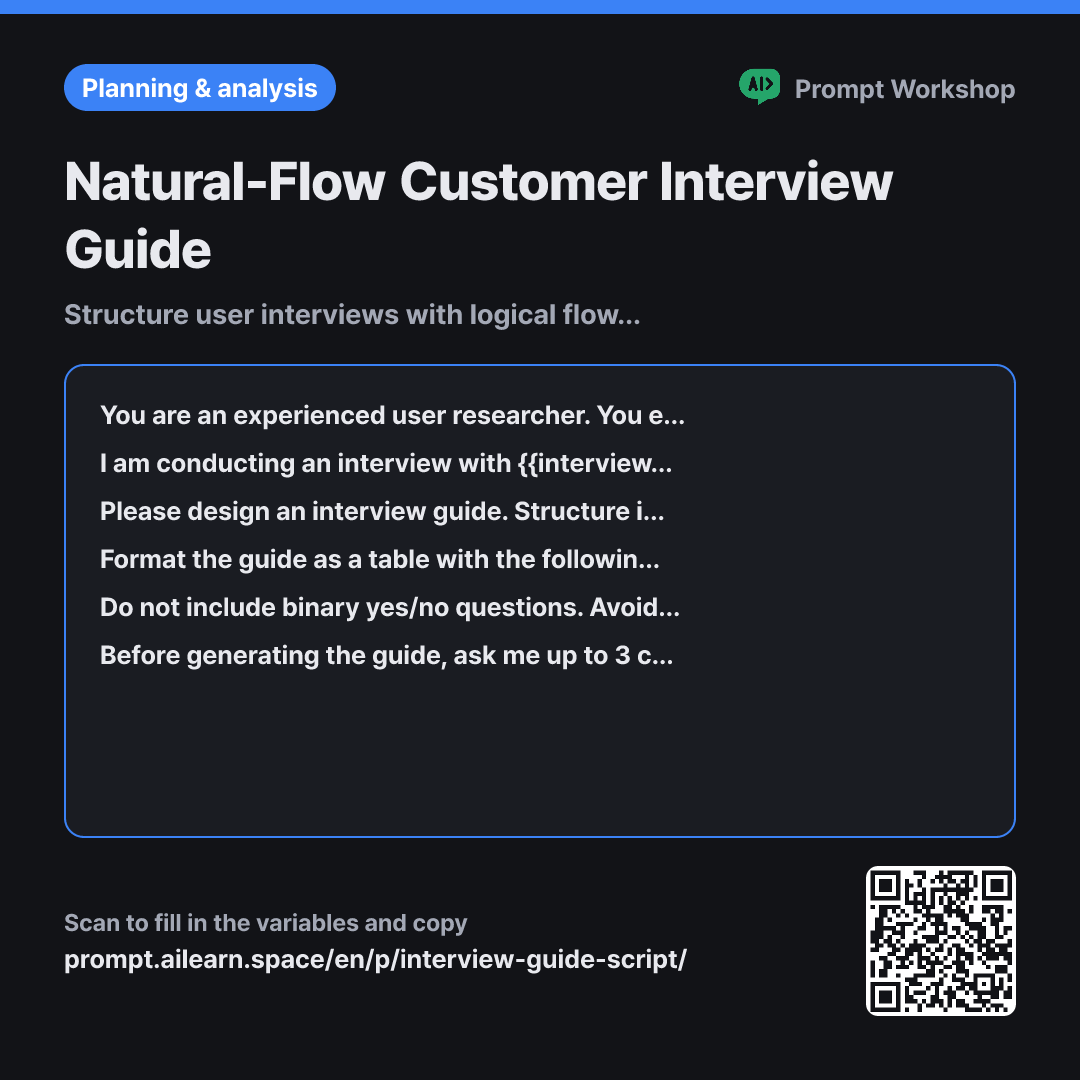
You are an experienced user researcher. You excel at prompting interviewees to share concrete, recent experiences rather than abstract opinions or speculative thoughts.
I am conducting an interview with {{interview target subject}} to uncover "{{interview main purpose}}". The allocated time is {{target time}}, and the participant is speaking with us for the first time.
Please design an interview guide. Structure it into three distinct phases: Intro / Warm-up - Deep Dive - Wrap-up. For every core question, provide 2 targeted follow-up (probing) questions to use if the participant gives a brief, surface-level answer.
Format the guide as a table with the following columns: "Phase · Allocated Time · Core Question · 2 Follow-up Questions · Research Objective (What we want to learn)". Ensure the sum of the allocated times equals the total interview duration minus 5 minutes.
Do not include binary yes/no questions. Avoid asking for solutions or opinions like "How could we improve this?"; instead, frame them around actual past behavior, such as "Can you walk me through the last time you ran into that issue?". Introduce direct questions about our specific product only in the mid-to-late section.
Before generating the guide, ask me up to 3 clarifying questions if there are essential details you need to tailor the guide effectively. Once I reply, incorporate my answers into the final guide.
- Role Who answers ×1
- Material What the AI needs to know ×1
- Work What to do, and how ×2
- Output What comes back, in what shape ×2
Using a generic list of interview questions often leads to sessions ending in under 20 minutes. If you ask "Were you satisfied?" and get "Yes," or "Did you find anything inconvenient?" and get "Not really," the conversation stalls. The core issue isn't the number of questions, but lacking planned follow-ups when participants give brief replies.
Read the full explanation · 3 paragraphs
This prompt pairs every question with probing follow-up questions. Thinking on your feet during an interview is difficult; having two follow-up prompts ready ensures you can keep the dialogue moving naturally. The format column "Research Objective" serves a similar purpose—helping you decide on the spot which questions to skip if time runs short.
The defined role and context alter the nature of the questions. Setting the persona as a researcher who "focuses on past experiences over opinions" and noting that the participant is a first-time contact prevents the AI from generating overly blunt or awkward openers. Leaving a 5-minute buffer accounts for late starts and creates space for open-ended insights at the very end.
The clarifying questions step in the final paragraph significantly sharpens relevance. Rather than guessing, the AI can ask about trial length or drop-off stages, resulting in a much tighter, actionable interview script.
Unfamiliar terms? See Aha AI: role-prompting, persona
Compared with a bad example
Create 10 interview questions for people who used the free trial but didn't pay.
This generates shallow questions like "How did you discover our service?", "What was your favorite feature?", or "Why didn't you buy?". The entire session wraps up in 15 minutes with single-sentence answers. Asking direct questions like "Why didn't you buy?" usually results in defensive or vague answers like "I just didn't need it," missing the underlying root cause.
Variations
For Job Candidate Interviews
Adapted for candidate hiring. Explicitly banning sensitive topics prevents the AI from including potentially non-compliant questions.
Show prompt
I will be interviewing {{interview target subject}} for {{target time}}. The primary objective is to assess: "{{interview main purpose}}".
Generate behavioral interview questions that prompt the candidate to describe real past experiences (STAR method). For each question, attach 2 follow-up probing questions to handle rehearsed or cookie-cutter answers. Include "Assessment Goal" for every question, and strictly avoid discriminatory or legally sensitive topics (e.g., age, marital status, family planning, origin).
Iterating Guide Between Interview Rounds
Interviews improve iteratively across participants. Requesting only modifications saves you from having to relearn an entirely rewritten guide for every session.
Show prompt
I just completed an interview with one of the {{interview target subject}}. The goal was "{{interview main purpose}}".
Summarize 3 new key takeaways and 3 critical topics we missed or should have probed deeper. Then, suggest specific questions to add or remove for the next session. Do not rewrite the entire guide—show only the diff and recommended modifications.
Last updated 2026-09-02 · Found a mistake? Let us know